Story by Tanner O’Neal Riley
Photo courtesy of Ryan Brunette
The Sinclair School of Nursing at the University of Missouri has churned out uniquely skilled nurses since its founding in 1920. Student nurse, Ryan Brunette, is one of them.
From the beginning, Brunette sensed that nursing could be more than a profession. It could be a way to live a life of service.
“At first I was drawn to nursing because of the variety of career paths it offers,” he said, recalling how the broad landscape of medical units first caught his attention. Emergency care, cardiology, oncology, each offered its own vantage point into the human condition. But variety alone wasn’t what pulled him in.
What held his attention, what ultimately shaped his commitment, was the intimacy of the work. “I realize that this career makes me feel human because it connects me directly with people during some of the most important moments of their lives,” Brunette explained. “Being part of their experiences, supporting them, listening, and helping them navigate challenges reminds me of the value of empathy and human connection.”
That sense of connection not only grounded him but also brought gratitude, an awareness of his own health, opportunities and ability to serve. “This combination of purpose and perspective is what solidified my decision to commit to nursing,” he said.
But Brunette’s journey didn’t stop at clinical education. Early on, he found himself drawn into another dimension of the field: research.
A New Door Opens
Most students don’t expect to enter research pathways in their first year but Brunette did, driven by curiosity and the desire to understand nursing beyond its hands-on components. “I was inspired to pursue research early because I wanted to understand nursing beyond the bedside and see how it can directly improve patient outcomes.”
His passion for oncology lit the path forward. He wanted to look closely at the experiences that linger long after treatment ends. “My passion for oncology motivated me to get involved in projects that explore challenges faced by cancer patients,” he said. “I’ve learned how evidence-based findings can inform care strategies and support patients more effectively.”
Through the Ann Crowe Essig Undergraduate Nursing Research Mentorship Program, he joined projects that allowed him to dig into the realities of survivorship, particularly for individuals navigating breast cancer’s long-term effects.
Lives Behind the Data
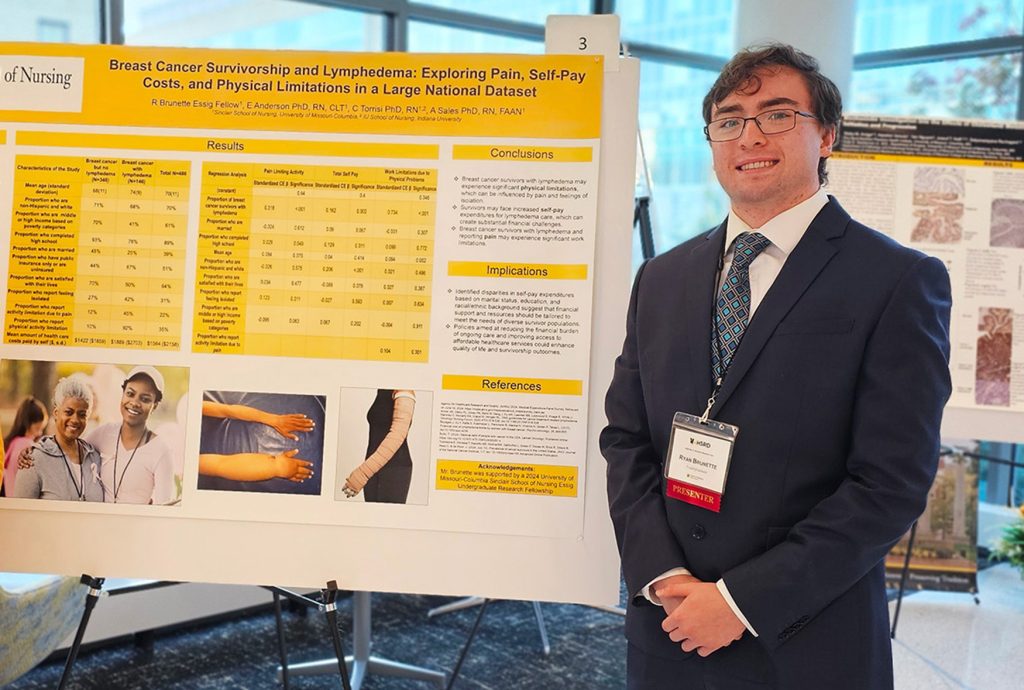
His research centered on lymphedema, a chronic condition that often follows breast cancer treatment and brings swelling, pain and debilitating physical limitations. Brunette wanted to understand what this experience looks like, far beyond the clinical definition. “I set out to explore how lymphedema affects pain, physical limitations and the financial burden of self-pay medical expenses,” Brunette said.
The questions were not abstract to him. “These questions mattered to me because I am passionate about oncology and improving the quality of life for patients beyond just treating the disease,” he explained. By analyzing population-level data, he hoped to identify patterns that could one day shape interventions, support services and more empathetic care plans.
It didn’t take long for him to realize the depth of what he was studying. Survivorship, he discovered, is layered and complex. “What has surprised me most as a student researcher is the complexity of the factors affecting patient outcomes and survivorship,” he said. Medical challenges, financial strain, emotional burdens, they all intersect in ways that aren’t always obvious in a hospital setting.
He was struck by how deeply non-medical factors influence the quality of patients’ lives. “I was also struck by how many social or financial factors, like self-pay medical costs or feelings of isolation, can have a profound impact on quality of life for cancer survivors,” he said. Research, he learned, is as much about listening as it is about measuring.
Shaping a Nurse-Scholar
The Essig Undergraduate Research Nursing Mentorship Program became a shaping force in Brunette’s personal and professional development. He said, “It has taught me to think critically about the questions we ask, the data we analyze and how those findings can directly impact patient outcomes.”
It also helped him understand how research and patient care intertwine. “It has strengthened my commitment to lifelong learning and has helped me see how research, clinical practice and advocacy can work together to make a meaningful difference.”
This balance, between research, coursework and clinical duties, is not easy. But Brunette approaches it with discipline sharpened by purpose. “I balance nursing coursework, clinical responsibilities, and research by setting clear priorities and staying consistent with my schedule.”
A moment during his research marked a shift in how he saw his future. While analyzing data on breast cancer survivors, the abstract became tangible. “Seeing the real-world impact of treatment side effects like lymphedema made my goal of improving quality of life for those affected by cancer feel much more concrete,” he explained. That clarity became a guiding force, pointing him toward oncology nursing.
A Community That Expands His Vision
Brunette’s work also thrives within the Honors College, where he has found mentorship, collaboration and unexpected opportunities to grow. “Through my Honors cohort this semester, I have had opportunities to present additional research on clinical decline in the hospital,” he said.
Those experiences taught him how to communicate complex ideas clearly, skills crucial for any healthcare professional. “It has also provided other avenues to immerse myself in information, such as developing infographics, creating presentations, and participating in discussions that challenge me to think critically about patient care and healthcare systems,” he added.
The Road Ahead
Looking forward, Brunette feels energized by the intersection of practice and research. “Right now, the possibilities that feel most exciting are those where I can combine clinical practice with research to make a real impact on patient care,” he said.
He envisions a future in oncology, working directly with patients, supporting families, and applying research insights to ease suffering and enhance quality of life. “I am excited about exploring ways to translate findings into practical strategies that improve outcomes and inform best practices.”
For Brunette, nursing is not simply a career. It is a promise, to listen, to understand, to heal and to keep learning. Through his work, his research and his quiet but unwavering compassion, he is shaping himself into the kind of nurse who sees the whole of a patient’s story and meets it with dignity.
It is, as he says, a career that makes him feel human. And one that will allow countless others to feel seen.