Story and photos by Logan Jackson
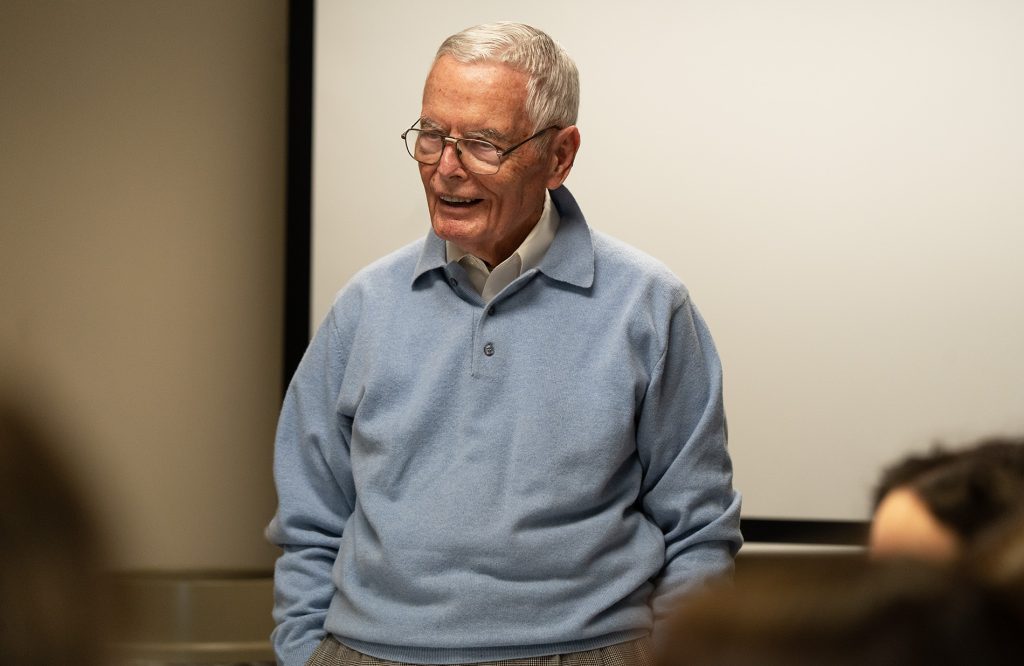
For the past 30 years, Gary Smith has brought the cases of renowned lawyer Clarence Darrow to life through a Mizzou Honors College Seminar course, “Attorney for the Damned” (GN_HON 1050H). Along with diving deeper into Darrow’s high-profile work, Smith engages with students on current events and Mizzou history.
“I have always been fascinated with history, and I think I maybe wanted to be a lawyer, but I never got around to it,” said Smith, director emeritus of admissions and registrar.
While Smith has been a staple at Mizzou and in the Honors College over the years, his path to becoming an educator started in a tiny Missouri town. After receiving a history degree from what is now Northwest Missouri State University, Smith completed an 18-month stint in the Air Force. He returned to his hometown – St. Joseph, Missouri – where he heard about a nearby high school that needed some help. He ended serving as a history teacher at Savannah High School for three years.
During Smith’s time as a high school history teacher, he spent his summers in Columbia, working on a master’s degree in education. He was eventually named the principal of the same small-town school.
“I was the principal for two or three years and realized I was ready for another challenge,” said Smith, who retired from the Air National Guard in 1995 as a full-bird colonel. “My advisor in Columbia was the late Neil Aslin, a former superintendent of schools in Columbia and chairman of the Mizzou Department of Education Administration. He encouraged me to pursue a doctorate at Mizzou. I came down in 1967 and have been here since.”
While working on his doctorate, Smith also took a job at Mizzou in the registrar’s office. He earned his Ph.D. in education in late 1970 and was named the director of admissions and registrar a bit later, in January 1971. He wore many hats in his director role and was dedicated to student success. He was an expert in building relationships between high schools and colleges and was at the forefront of incorporating automated registration. He was part of numerous boards and conferences throughout his time as director and officially retired from the role in 2000.
“I was fortunate enough to be in the right place at the right time,” Smith said. “I really enjoyed that role and the opportunity to work with students across campus.”
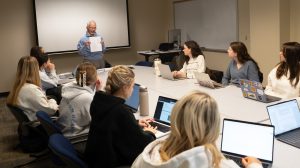
Smith began teaching his Honors College course just before his retirement and finished another semester of the class this past fall. While there have been a few changes over the years, the heart of the class has stayed the same. Smith wants students to develop their public speaking skills, learn how to work as a team and hone their research abilities, all while gaining a better understanding of Darrow’s work as a lawyer.
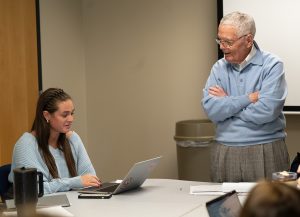
“I’ve read a lot on Darrow over the years, and I find his work really captivating,” Smith said. “I developed this course which focuses on his four or five highest profile cases, and I thought the Honors College would be a good spot for it. I’ve been very fortunate to be able to teach the course as long as I have.”
His class period typically begins with a conversation on current news and world events, with students required to do research on what’s happening across the globe. The students then participate in open discussions on the specific Darrow case that Smith lectures on. He mixes in fun tidbits about the history of Mizzou throughout the semester, too.
“Students walk back and forth across campus, passing by so many buildings and structures that are named for individuals scattered throughout the history of our campus,” Smith said. “Each week, I assign them a person or a building or something from Mizzou’s history to research and learn more about. Our campus is rich with history, and I think it’s important for students to have a bit of knowledge about the university.”
Smith has given back to Mizzou in multiple ways and was honored with the Distinguished Service Award by the Mizzou Alumni Association in 2010. He said the opportunity to interact with students each semester keeps bringing him back to the classroom every fall. Smith added that it’s another great way to give back to Mizzou.
“I like being around the young people,” Smith said. “They keep me young and keep me going. Once in a while I’ll have a student come up to me and say that their parents took my class and wanted them to make sure and take it as well. That’s really heartwarming.”