Story by Riley Palshaw
Eight World Series rings sat on a classroom desk as 93-year-old former Major League Baseball scout Bill Clark told stories from more than four decades in the game. For students in the University of Missouri Honors College, it wasn’t just a lesson about baseball; it was a lesson about American history.
That moment is exactly what Bill Horner hopes students experience in Baseball and the American Experience, a course that explores how the story of baseball mirrors the story of the United States itself.
Horner, a Curators’ Distinguished Teaching Professor in the Truman School of Government and Public Affairs and affiliate faculty in the Honors College, revived the baseball course in honor of the late Mike Perry, a former Mizzou instructor who once taught a similar class. Perry, who was also Horner’s physician, passed away from cancer several years ago, and the two had often talked about baseball and the class Perry used to teach. After Perry’s passing, Horner reached out to his family and, with their support, decided to bring the course back as a tribute to Perry and his love of the game.
Now in his 26th year at Mizzou, Horner is teaching the course for the first time this spring and hopes to offer it each year moving forward, timing it with the start of baseball season. If early interest is any indication, he may have a hit on his hands, as Horner said he’s never had a class fill so quickly in his career.
“When I saw this course listed on the Honors catalog,” said senior journalism major Charlie Dahlgren, “it was kind of a no-brainer having it be a Horner class related to baseball.”
The course is structured like a baseball game, divided into nine “innings,” each exploring a different moment in baseball history. Students examine topics ranging from the origins of the sport in the 19th century to the rise of radio and film, the civil rights movement, women in baseball and the modern analytics revolution.
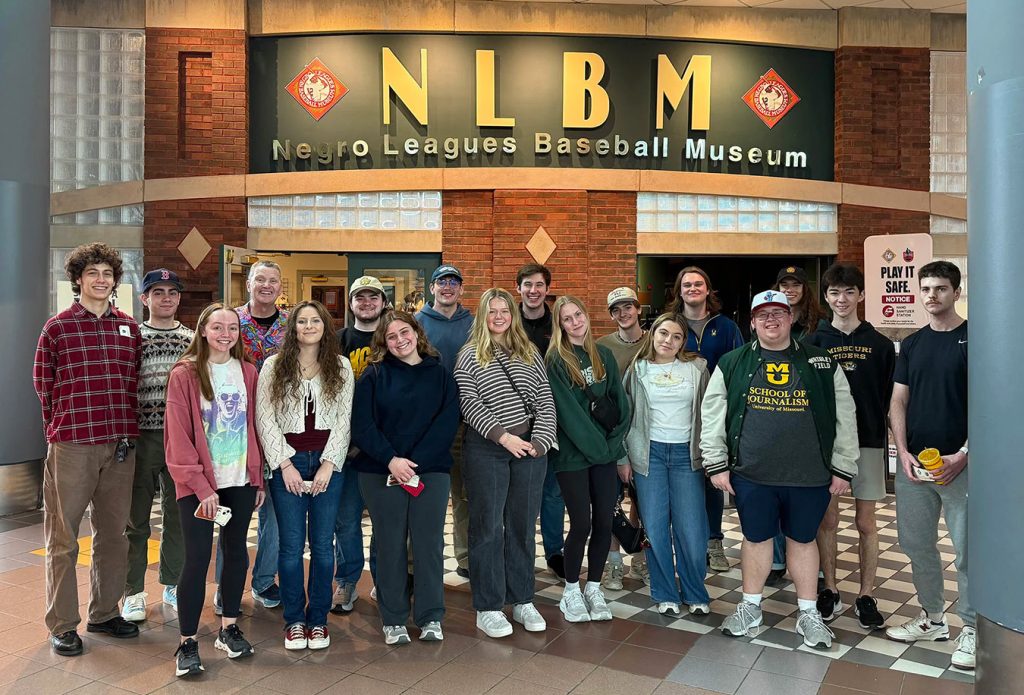
Throughout the semester, Horner invites guests from across the baseball world to connect those historical themes to real-life experiences. Recent visitors include Bob Kendrick, president of the Negro Leagues Baseball Museum; Bill Clark, a former MLB scout who brought his eight World Series rings to class; and performance artist Dan Kwong, who recreated a baseball diamond at the Manzanar Relocation Camp to honor Japanese Americans who played the game while interned during World War II.
For Horner, baseball provides a powerful way to explore complicated moments in American history.
“History is there and things happened,” Horner said. “And I think baseball is a great vehicle to use to bring up those topics.”
This sense of accessibility is reflected in the students themselves, who come from a wide range of backgrounds, from lifelong fans who can recite statistics to those with little prior knowledge of the game. Students say the course not only deepens their understanding of history but also changes the way they view the game itself.
“It’s not only left me appreciating the history more, but it’s also left me appreciating the game of baseball more,” Dahlgren said. “It kind of seems like this Americana thing that reflects our country more than I ever thought.”
For others, the course stands out for its experiential nature and the opportunity to hear from guest speakers.
“All of these cool people are coming to talk to our class and that just shows how important baseball is to people,” said senior Amber Winkler, an anthropology and journalism double major. “They hear there’s this new baseball class at Mizzou and they want to come speak to it. It makes sense, baseball spans far and wide.”
That collaborative environment extends beyond the classroom. As a final project, students interview someone about their personal connection to baseball and develop those stories into narratives. Selected pieces will then be transformed into monologues in partnership with Professor Heather Carver’s theater class, bringing those experiences to life for Horner’s students to watch on stage.
For Horner, that final project, and the course as a whole, reflects something larger than the game itself.
“Baseball is this common thing that brings a lot of people together regardless of everything else that divides them,” Horner said. “It’s this common ground that for close to 200 years has been able to bring people together.”