Story and photos by Logan Jackson
For Carolyn Orbann, anthropology has always been about people — their stories, their cultures, the systems they build and the ways they care for one another across time.
That curiosity has carried her from childhood years spent overseas in Kenya and South Africa to archaeological work in Joshua Tree National Park, and eventually to classrooms and research laboratories at the University of Missouri, where she now mentors Tigers exploring questions about health, policy and human behavior.
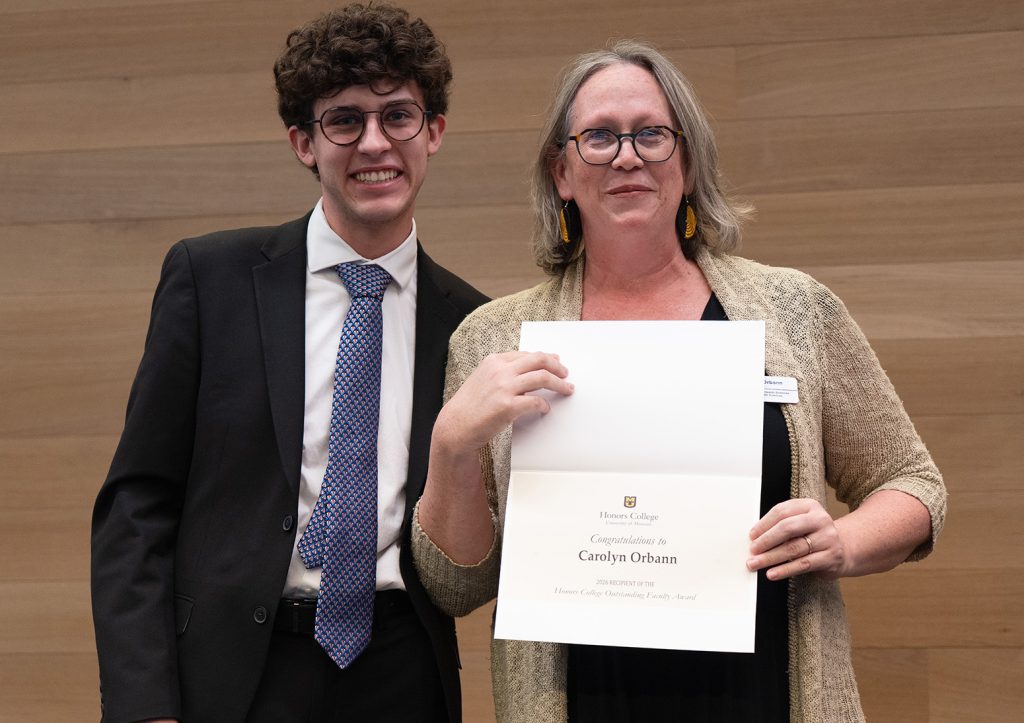
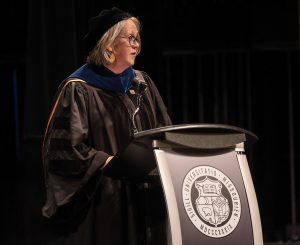
This spring, Orbann, a teaching professor in the College of Health Sciences and affiliate faculty in the Honors College, was named the Honors College Outstanding Faculty Award recipient and spoke yesterday at the Honors commencement ceremony.
“It was really, really nice,” Orbann said. “Having something unexpected like this happen was incredibly meaningful.”
The award reflects years of teaching and mentorship that have made Orbann a familiar presence in the Honors College. She has served on Honors committees, reviewed applications and worked with students across disciplines. She’s also been a regular at Honors commencement ceremonies, reading the names of graduates as they walk across the stage to receive their cord.
“Getting involved in the Honors College happened very naturally,” Orbann said. “There are so many awesome people in the Honors College, so it’s always a pleasure to work with faculty and students who are involved.”
That willingness to say yes has shaped much of Orbann’s career.
Raised in a military family, Orbann moved frequently as a child and spent several years living abroad. Those experiences introduced her to different cultures early in life and sparked an interest in how people and societies function.
“I think people are just super interesting,” Orbann said. “I love reading about them and thinking about society and culture and time and space.”
She initially entered George Washington University as a biology major, but everything changed after taking a biological anthropology course during her freshman year.
“I realized biology wasn’t exactly what I cared about,” Orbann said. “I wasn’t interested in cells. I was interested in people and how things change over time.”
After earning her undergraduate degree, Orbann moved to California to pursue a master’s degree at California State University, Chico, where she continued to study anthropology. Near the end of the program, she accepted a position with the National Park Service at Joshua Tree National Park as an archaeologist.
But research continued pulling her forward.
Orbann eventually came to Mizzou to pursue a PhD in anthropology, drawn by the opportunity to work with anthropologist Lisa Sattenspiel. While completing her doctorate, she began teaching courses in the College of Health Sciences, a path that ultimately led her to a full-time faculty role.
Today, Orbann’s work sits at the intersection of anthropology, public health and history.
Much of her recent research focuses on mortality and historical health trends in Missouri, using death certificates dating back to the early 1900s. Because Missouri is an open-records state, Orbann and her students can access historical death records that are unavailable in many other states.
What began as a project studying the 1918 influenza pandemic in Missouri quickly grew into a larger effort examining how causes of death changed over time, particularly in rural communities.
“We realized there was all of this information that nobody had really studied,” Orbann said.
The research has become deeply collaborative, involving Honors College students, McNair Scholars and undergraduate researchers who help collect and analyze data from counties across Missouri.
For Orbann, one of the most rewarding parts of the project is how personal the work becomes.
“You start seeing the humanity behind the records,” Orbann said. “Sometimes there are stories that are heartbreaking or mysterious or surprising.”
In one instance, a student researching southwest Missouri discovered death certificates connected to a tornado that devastated a small town in 1920. By pairing the records with digitized newspaper archives, the student was able to reconstruct what happened and better understand how communities experienced disaster and loss.
“It really humanizes the past,” Orbann said.
That ability to connect research with lived human experience also defines her teaching.
Orbann teaches Honors sections of healthcare and health policy courses that attract many pre-med students, though she often encourages students to think more broadly about what meaningful work can look like.
“A lot of students come in believing they have one very specific path,” she said. “Sometimes they just need the permission to realize there are other things they could do.”
As she addressed Honors College graduates, Orbann said she hopes students continue allowing themselves room to grow, change and follow unexpected opportunities — much like she did herself.
It simply began with curiosity about people and a willingness to keep asking questions.