Story by Riley Palshaw
Photos by Logan Jackson
Students in the University of Missouri Honors College are not just learning how to improve their own writing. In Theory and Practice of Tutoring Writing, they are learning how to help others do the same, continuing a tradition of support at the University of Missouri Writing Center that spans 50 years.
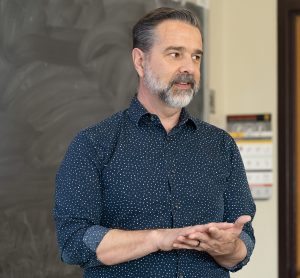
The 15-week Honors College course prepares students to work in the MU Writing Center through a mix of writing, observation and hands-on experience. Led by MU Writing Center director Aaron Harms and assistant director Bailey Boyd, the class emphasizes both theory and real-world practice. By the end of the semester, many students go on to become tutors themselves.
Originally introduced in the late 1980s by Elaine Hocks as a one-credit Honors College internship, the course was once geared primarily toward English and English education majors. In 2007, Rachel Harper expanded it into a three-credit course and opened it to students across campus, reflecting a broader understanding of writing as a skill that crosses disciplines. That shift is visible today, with about half of enrolled students coming from STEM fields such as biology and biochemistry.
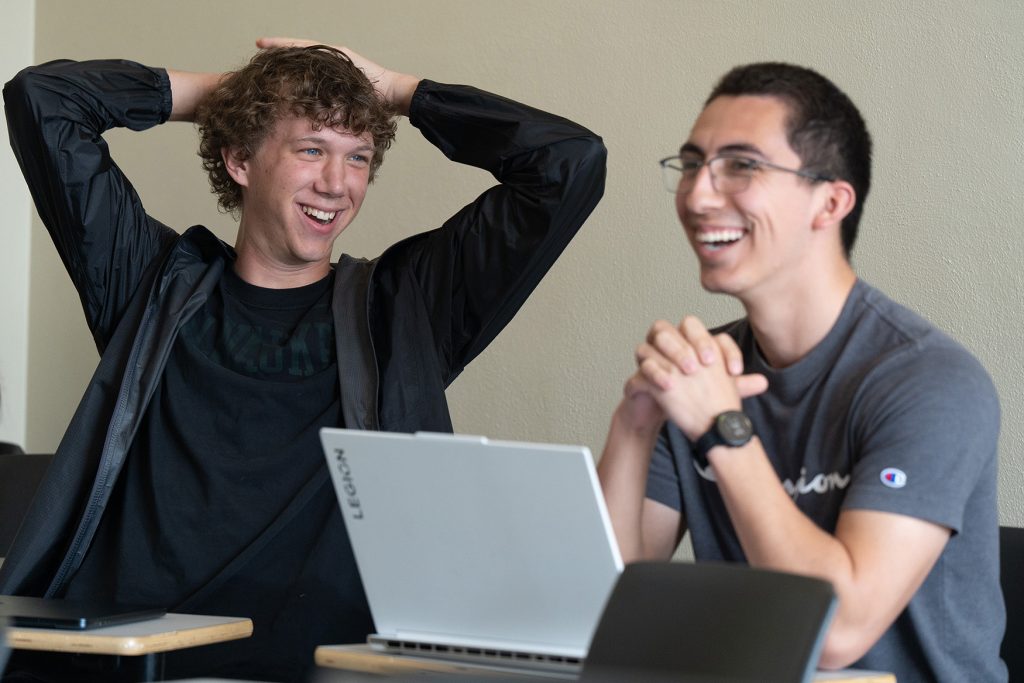
Throughout the semester, students complete assignments focused on communication, including analyzing body language and responding to drafts as if they were in a tutoring session. A central component of the course is observing real Writing Center sessions, with students completing 10 observations and reflecting on what they see and how it connects to course concepts.
“Most of the students tend to say that the on-the-job part was so important because it really prepped them for the idea that this is what that looks like in real life as opposed to this is what it looks like in class,” said Boyd.
For many students, those real-world experiences become the most defining part of the course.
“The collective experiences I’ve had at the Writing Center have far surpassed my expectations when I stepped into the classroom for the first time,” said senior Kate Lopez, a journalism major. “I knew tutoring would be something I’d enjoy but didn’t realize how it would transform my college experience.”
That kind of impact is exactly what MU Writing Center staff hope students take away from the course.
“This is one of those jobs that will translate to every other job,” said Boyd. “It’s about how to work with people, and it’s about how to give feedback to people whether they’re your peer, or a senior and you’re a sophomore, or maybe they’re in an advanced engineering class and you’re in a humanities program.”
Beyond preparing students for tutoring, the course also functions as a direct pipeline into the Writing Center. As Harms described it, it is “a 15-week job interview,” with about 90 percent of students accepting tutoring positions after completing the class.
At the same time, instructors stress that the value of the course is not limited to those who become tutors.
“If you engage with the course, I guarantee you will come out of that class more interested, more curious and more engaged with the world around you,” Harms said.
That engagement often centers on a simple question that guides both the course and the Writing Center’s mission: how to help others.
“Writing tutoring isn’t just about leaving with a better product,” said sophomore journalism major Alegria Aguilera. “It’s about developing the skill of writing. Seeing students come back gives us the opportunity to watch those skills improve, and watch writers become more confident.”
As the Writing Center approaches its 50th anniversary, that focus continues to resonate, with nearly 1,000 alumni who remember specific moments from their time in the program.
“I absolutely loved the camaraderie in the Writing Center which definitely started during the class,” said Madison Reiser, former tutor and 2024 Mizzou graduate. “I joked at the time that the culture of the Writing Center had ruined me for all future jobs, but it actually became the blueprint for what I looked for post-grad.”
For instructors, that lasting impact is what makes the course meaningful. When it comes to mentoring these students, Harms puts it plainly: “pun intended, it’s an absolute honor.”