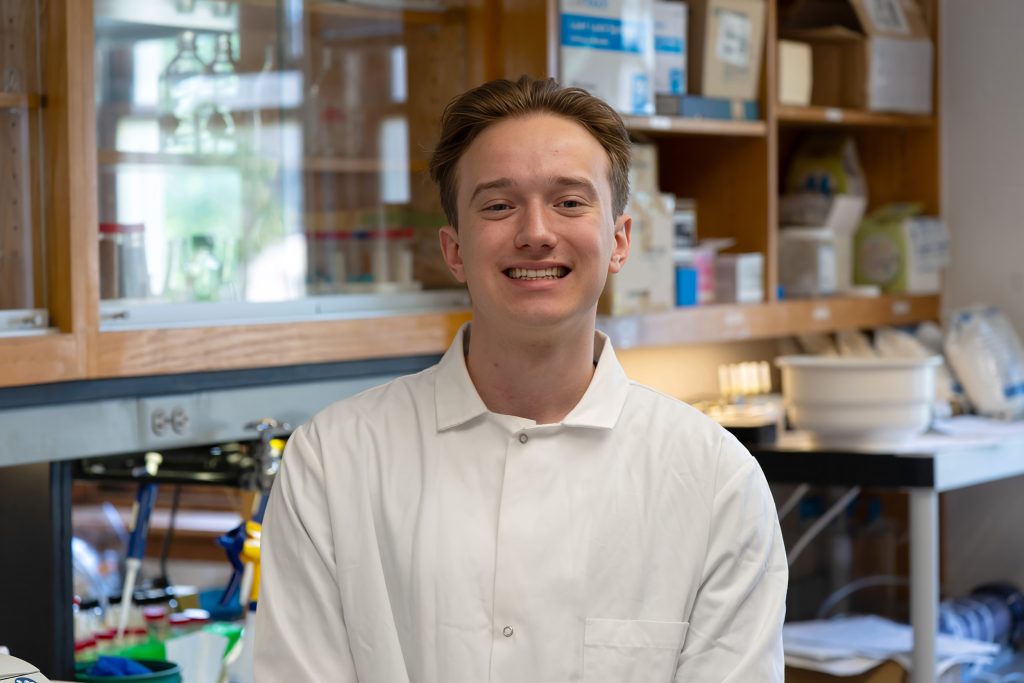
Story and photos by Logan Jackson
- Noah Davis – sophomore plant sciences major
- Research Mentor: Jaime Barros-Rios, assistant professor in plant molecular biology in the College of Agriculture, Food and Natural Resources
Noah Davis was scrolling through YouTube shorts late one night when one video caught his attention. The short featured scientists discussing a variety of research developments in plant science. Davis had cared for houseplants for years and remains passionate about all things plants.
“I was just thinking about how cool it was that researchers were doing this high-level work, and I was interested in what would eventually happen,” Davis said. “I then realized that I could be part of that type of work; I could help find answers to challenging questions.”
Davis was in high school when he came across the YouTube short. Davis just completed his first year at Mizzou but actually began his research journey last summer before his first semester on campus. He reached out to Jaime Barros-Rios, an assistant professor in plant molecular biology in the College of Agriculture, Food and Natural Resources, to see what opportunities were available.
“Dr. Barros-Rios brought me last summer, and we were able to talk for a bit,” Davis said. “He was willing to let me jump in and begin research early, which I’m so thankful for. I was able to start a research project on the dry-grind bioethanol process, a common method for producing fuel ethanol, that led to my first publication, which is currently under review.”
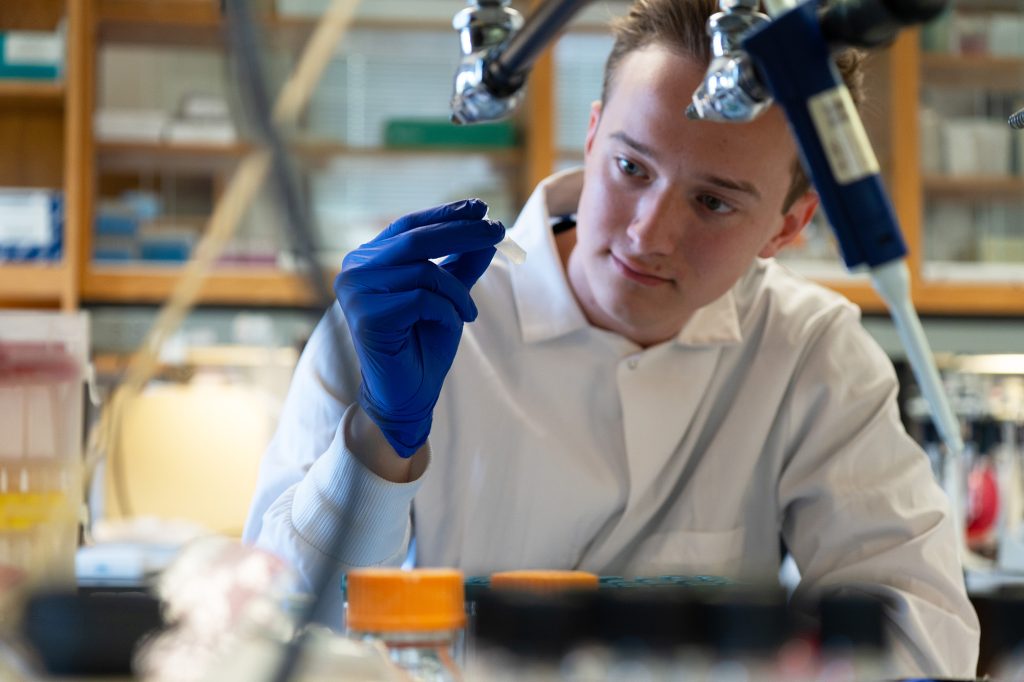
Davis, a sophomore plant sciences major, is building on his research tied to the dry-grind bioethanol process this summer. He’s specifically focused on lignin, a complex polymer that serves as a binder in the cell walls of most terrestrial plants.
“A lot of lignin passes through during this process, and it ends up in co-products that are used as animal feed,” Davis said. “I’m hoping to take the lignin out of the process to increase the value of co-products and also potentially use the lignin for other biomaterials and biofuels.”
Davis said there are only a few biological ways to break down lignin. There are some species of fungi that have developed enzymes that can aid in that breakdown. His research centers on putting one of those fungal enzymes into yeast and incorporating that yeast into the dry-grind process.
“What I’ve mostly been working on is setting up the yeast transformation process,” Davis said. “This is something I haven’t done before, and no one in our lab does this type of transformation, so I’ve been reaching out to other labs to see what methods they’ve used.”
Davis has been able to continue his research this summer through the Cherng Summer Scholars program. The program, supported by a gift from Peggy and Andrew Cherng, is a nine-week research or creative scholarship program for Mizzou students pursuing the Honors Certificate. The program allows students to participate in individually designed projects under the mentorship of a Mizzou faculty member. Students also take part in a weekly seminar course and present their research findings during Mizzou Office of Undergraduate Research’s Summer Forum.
“It’s been great to have the freedom to continue my work with the help of this scholarship,” Davis said. “I’ve really enjoyed having the community that comes with the program, too.”
Barros-Rios has continued to serve as Davis’s research mentor this summer. Davis said Barros-Rios has been vital as he grows as a scientist, especially when it comes to explaining his research.
“There is quite a bit of distrust in science currently, so I think communicating science in a concise way is an important skill that young researchers need to build,” Davis said. “We have to be able to share our results in a way that the broader public can understand so that we can build back that trust in science.”