Story and photos by Logan Jackson
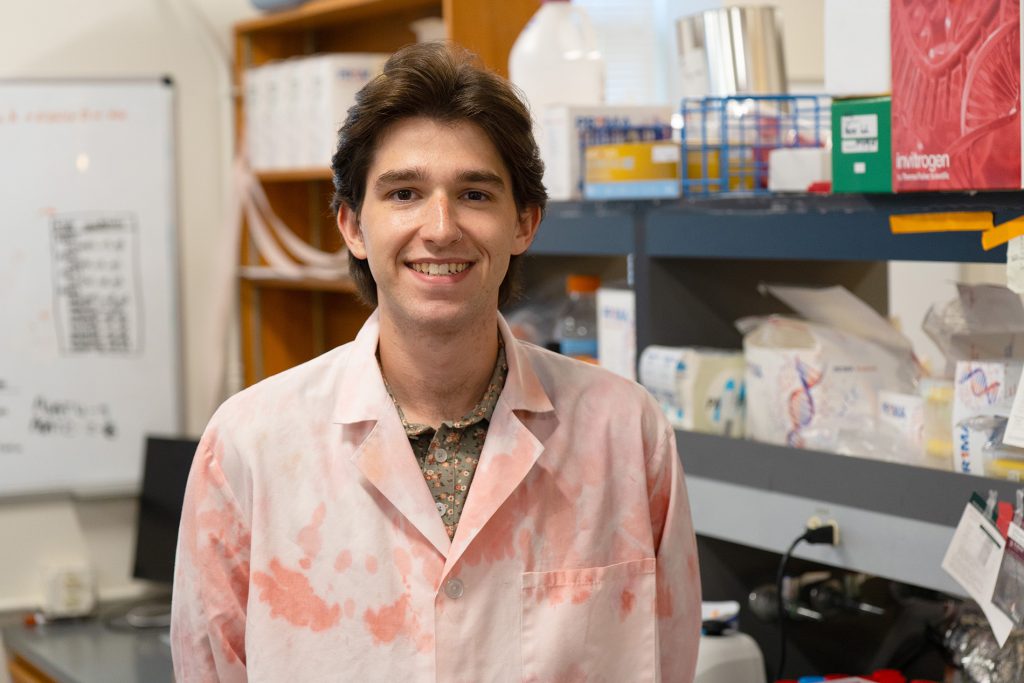
- Jacob Hicks – junior plant sciences major
- Research Mentor: Craig Schenck, assistant professor of biochemistry
Two unique programs allowed Jacob Hicks to jumpstart his research journey when he arrived on the University of Missouri campus two years ago. This summer, another program allowed Hicks to build on the important work he began as a freshman.
Hicks earned the Brazeal Scholarship as a freshman, an award for students pursuing the Honors College Certificate that was created in 2004 by Jim and Cathy Brazeal in order to attract and retain the best young scholars to the Mizzou campus. The scholarship allows recipients the opportunity to pursue research in a field that interests them. Hicks was also selected for the FRIPS (Freshman Research in Plants) Program, which is designed to expose new college students to the vital and exciting research being done with plants and to encourage them to consider a research career in plant biology.
“Being able to get involved in research right away was really important to me,” said Hicks, a junior plant sciences major. “I wanted to be able to build a strong foundation, and both of those programs allowed me to do so.”
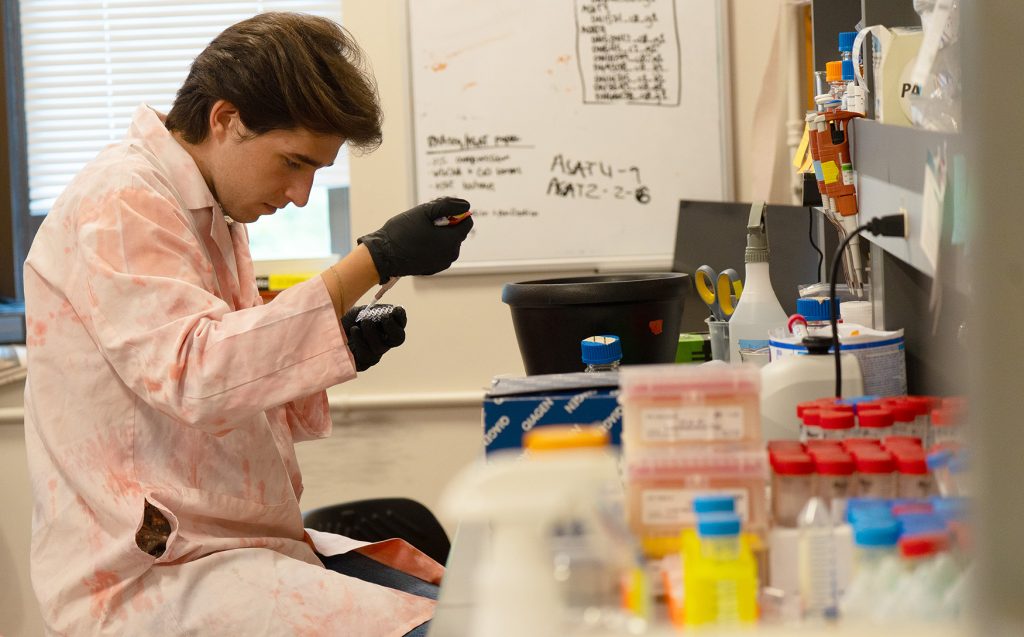
Through the FRIPS Program, Hicks was connected with Craig Schenck, an assistant professor of biochemistry. Schenck has continued to serve as a research mentor to Hicks since then, including this summer through the Cherng Summer Scholars program.
“I love this lab, so it was exciting to be able to continue my work through the summer,” Hicks said. “Everyone who works here is amazing, and Dr. Schenck has been incredible as a mentor. He’s very encouraging, and I’ve learned so much from him during my time in the lab.”
The Cherng Summer Scholars program, supported by a gift from Peggy and Andrew Cherng, is a nine-week research or creative scholarship program for Mizzou students pursuing the Honors Certificate. The program allows students to participate in individually designed projects under the mentorship of a Mizzou faculty member. Students also take part in a weekly seminar course and present their research findings during the Mizzou Office of Undergraduate Research’s Summer Forum.
“This program is really important in learning how to communicate your research to a wide variety of audiences,” Hicks said. “It’s interesting because while we’re all working on different projects and have different goals, we do have shared experiences. We all have setbacks and triumphs. It’s exciting to be able to discuss those together and hear different perspectives on how to handle a situation.”
Hicks’ research this summer centered on plants in the nightshade family, which includes more than 2,500 species such as tomatoes, potatoes and peppers. These plants contain genes involved in producing compounds called acylsugars. Those sugars help defend the plants against various threats, like insects, viruses, fungi and even some environmental stresses. While the compounds share a basic structure, small variations can give them different functions.
“There are a lot of potential things that these compounds can do, and there’s a lot that we don’t understand about how they’re made,” Hicks said. “For example, we don’t know a lot about how those components move throughout the plant to where they need to be. We do know some information, though. All of the plants in this family have the genes that encode enzymes involved in producing acylsugars, whether they actually produce them or not.”
Hicks worked to identify the coding sequence for that first gene, ASAT1, which provides instructions for an enzyme that helps build acylsugars. Specifically, the enzyme attaches the first acyl chain to the sugar at the center of the compound.
“Many of the plants in this family are major agricultural crops,” Hicks said. “It would be very advantageous if we could figure out ways to better defend them in agricultural settings. Our work aims to understand the basic science of how the acylsugars are produced because of the real-world implications.”