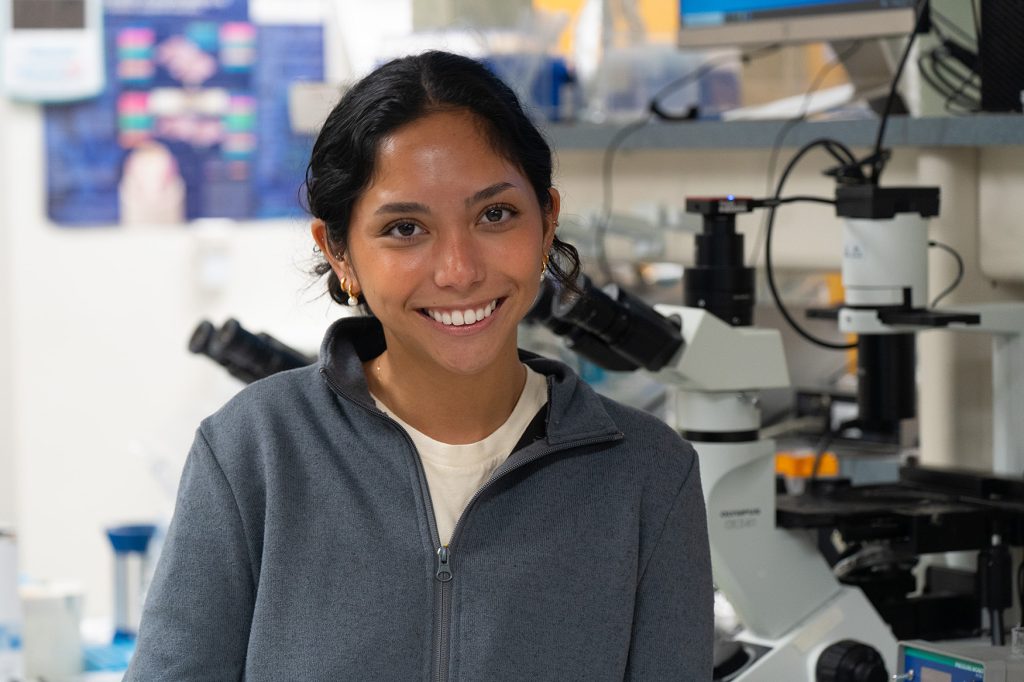
Story and photos by Logan Jackson
- Madeline Claravall – junior biological sciences major
- Research Mentor: Zhe Sun, assistant professor in the Dalton Cardiovascular Research Center
While Madeline Claravall wasn’t thrilled about the idea of joining a research laboratory early in her collegiate career, she knew the experience would be an important one as she eventually began applying to medical schools. A biological sciences major on the pre-medicine track, Claravall reluctantly began the search during her freshman year.
Now a junior with more than a year of research under her belt, Claravall admits that the hands-on lab experiences have been both academically and personally fulfilling.
“I definitely approached research as a checkbox,” Claravall said. “I knew having some research experience would be important, but I really didn’t want to do it. Even though I didn’t know what to expect coming to my current lab, I quickly realized that I would be able to get some great hands-on experiences. Now, I love coming to the lab.”
Claravall works in the laboratory of Michael Hill, a professor in the School of Medicine and investigator in the Dalton Cardiovascular Research Center. Her direct supervisor is Zhe Sun, an assistant professor in the Dalton Cardiovascular Research Center, who she has worked closely with this summer through the Cherng Summer Scholars program.
The Cherng Summer Scholars program, supported by a gift from Peggy and Andrew Cherng, is a nine-week research or creative scholarship program for Mizzou students pursuing the Honors Certificate. The program allows students to participate in individually designed projects under the mentorship of a Mizzou faculty member. Students also take part in a weekly seminar course and present their research findings during Mizzou Office of Undergraduate Research’s Summer Forum.
“Mizzou offers a lot of great programs, but the Cherng Summer Scholars program really stood out to me,” Claravall said. “The way that it is structured and the resources that it offers are exciting. I was very thankful to have the opportunity to join this outstanding cohort.”
Claravall added that support from the MedOpp Advising Office has played a major role in her journey as a pre-medicine student. Coming from a family with very little medical background, she felt unsure where to begin when she arrived at Mizzou.
“MedOpp has been such a blessing because I don’t have anyone in my family who’s a doctor,” Claravall said. “I had no clue what the steps were to even start imagining medical school. My advisor, Darcy Holtgrave, really helps me, no matter what questions I have. I really enjoy working with her and the entire team.”
Claravall’s research this summer centered on prolonged vasoconstriction, one of the most serious complications that can follow a hemorrhagic stroke and occurs when the brain’s blood vessels remain abnormally tightened long after the medical crisis. When those vessels stay constricted, blood flow to the brain drops, increasing the risk of long-term neurological damage. Research shows that the tightening is driven by a cellular process called myosin light chain phosphorylation.
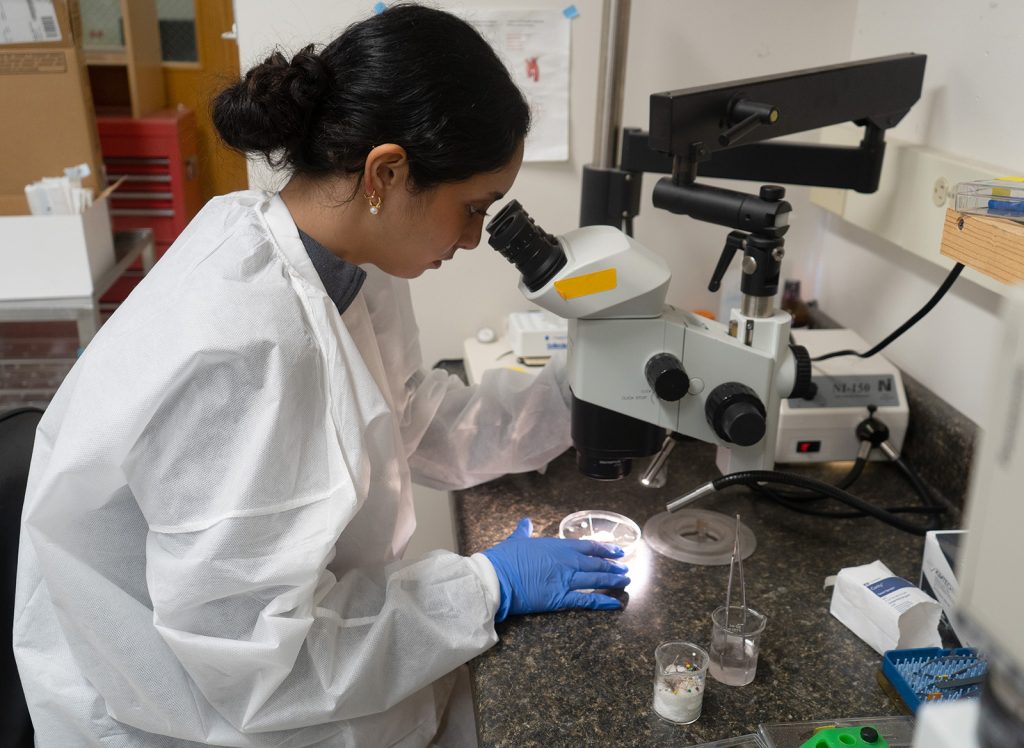
Her summer project examined whether other mechanisms also contribute to why the vessels fail to relax. To investigate this, she performed highly technical vascular experiments using brain tissue from mice.
“Very carefully, I would extract the superior cerebral artery from the brain and mount the vessel onto a specialized cannulation system,” Claravall said. “I would then suture the artery in place, seal any leaks and use pressure myography to expose the vessel to different pressure conditions.”
Claravall also induced vasoconstriction and flash-froze the vessels at precise time points. The samples were fluorescently labeled to measure levels of myosin light chain phosphorylation, which allowed her to compare how the vessels behave during acute versus prolonged constriction.
“I feel really, really fortunate and blessed because there is such a big learning curve when it comes to research,” Claravall said. “My work has allowed me to develop skills that are going to serve me well in the future. I don’t think freshman me would have thought that I could ever do something like this.”