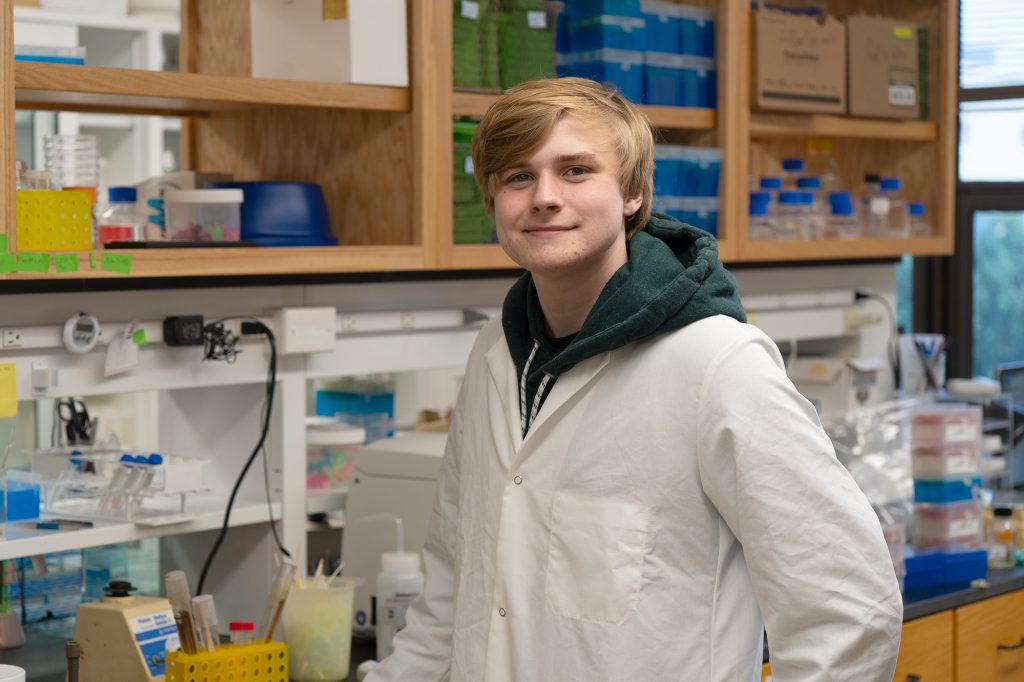
Story and photos by Logan Jackson
- Archer Stone – junior biological sciences major
- Research Mentor: Caroline Grunenwald, assistant professor of biological sciences
When Archer Stone began searching for potential research laboratories to join two years ago as a Discovery Fellow, there was one that piqued his interest. Caroline Grunenwald, an assistant professor of biological sciences, studies Staphylococcus aureus, a bacterium commonly known as staph. She’s specifically interested in its stress responses at the host-pathogen interface.
It’s an infection that has a personal connection for Stone.
“My sister got sick with staph when I was younger, and it was really bad,” Stone said. “There was a lot going on; it was super scary stuff. While I always knew I was going to be involved in a research field of some kind because I am just very innately curious, my interest in biology began during that time period. I wasn’t necessarily looking for research directly tied to staph, but it is motivating to have that personal tie to the work.”
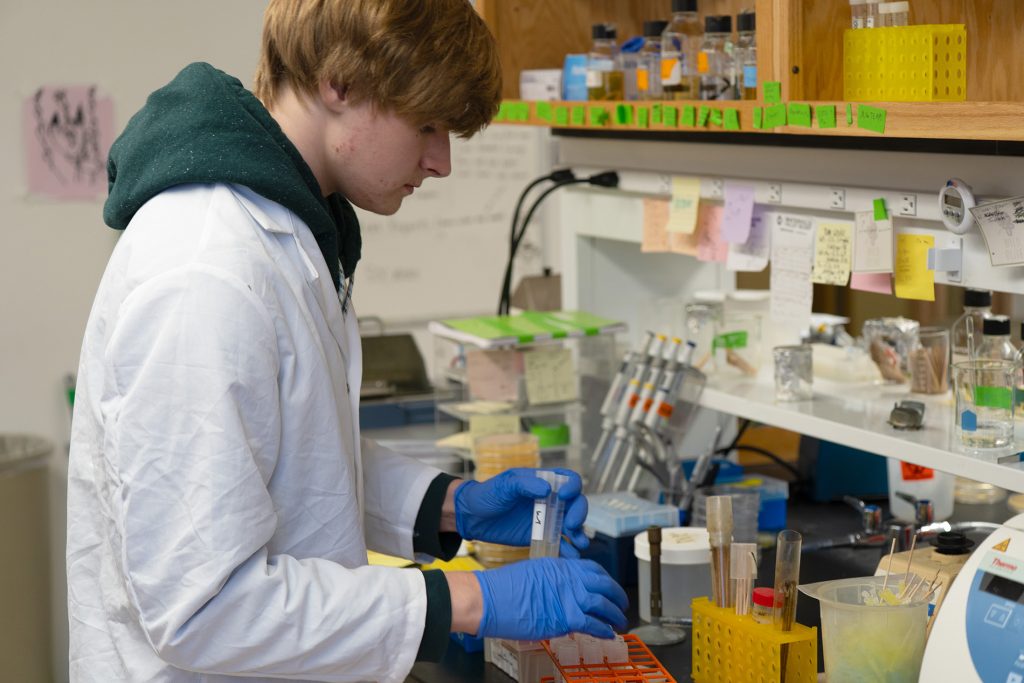
Stone, a junior biological sciences major, has been part of Grunenwald’s lab for nearly two years. Last summer, Stone worked with a post-baccalaureate student who studied a strain of staph that was missing one of its main manganese exporters. Researchers found that, in some cases, a second mutation could compensate for the loss of the manganese exporter. Several of these mutations were identified, and Stone spent this summer researching the protein affected by one of them.
“There’s this gap where we don’t know what this protein is doing, but we have some basis for thinking it’s related to manganese in some way,” Stone said. “The goal is to figure out what that protein is actually doing.”
Most of Stone’s research focused on studying the phenotypes of that protein. He used a copy of staph that had a nonfunctional version of his protein and put it under a variety of stresses to see how it differed from a baseline strain of staph.
“My research has led to more questions which will eventually lead to even more questions about this little protein,” Stone said. “That’s what’s exciting about research. This has been a great project; I love it.”
Stone was able to devote the summer to the project through the Cherng Summer Scholars program. The program, supported by a gift from Peggy and Andrew Cherng, is a nine-week research or creative scholarship program for Mizzou students pursuing the Honors Certificate. The program allows students to participate in individually designed projects under the mentorship of a Mizzou faculty member. Students also take part in a weekly seminar course.
Grunenwald continued to serve as Stone’s research mentor throughout the summer.
“It was really cool to be part of the program,” Stone said. “I liked hearing about each project, and it was neat to talk through how we’re solving these big questions. I enjoyed seeing how interdisciplinary the group was, too. It was fascinating to see the unique perspectives that were brought together through the program.”
While the Cherng Summer Scholars program allows students to gain in-depth research experience, it also gives students opportunities to share their research with numerous audiences. All participants presented their research findings during the recent Mizzou Office of Undergraduate Research Summer Forum.
“It’s really important to bridge that gap in knowledge,” Stone said. “Science communication is a skill that one can always work on. It’s great that we have the opportunity to present our work and have those conversations.”